
Data Centricity
Data Centricity addresses the vision that, because data is forever while applications come and go, we should make our data available to our business and ecosystem partners in a different way. We do this because data as a resource gives us the opportunity to create new products and services over and over again from that same resource. When taking a data centric approach we can develop new products independently of specific applications. We can also apply security and compliance measures to the data instead of the applications, making security and compliance more effective and easier to implement. On top of that we will get rid of unnecessary date integration.
Data Centricity is a big goal that requires significant changes in the way we do IT today. There will be many obstacles to overcome, but in the end this will help us making IT more stable and easier to change and operate.
Data Centricity Goals
To become data centric, we design our solution around data, share out data as much as possible thus enabling data-driven decision making and product or service creation.
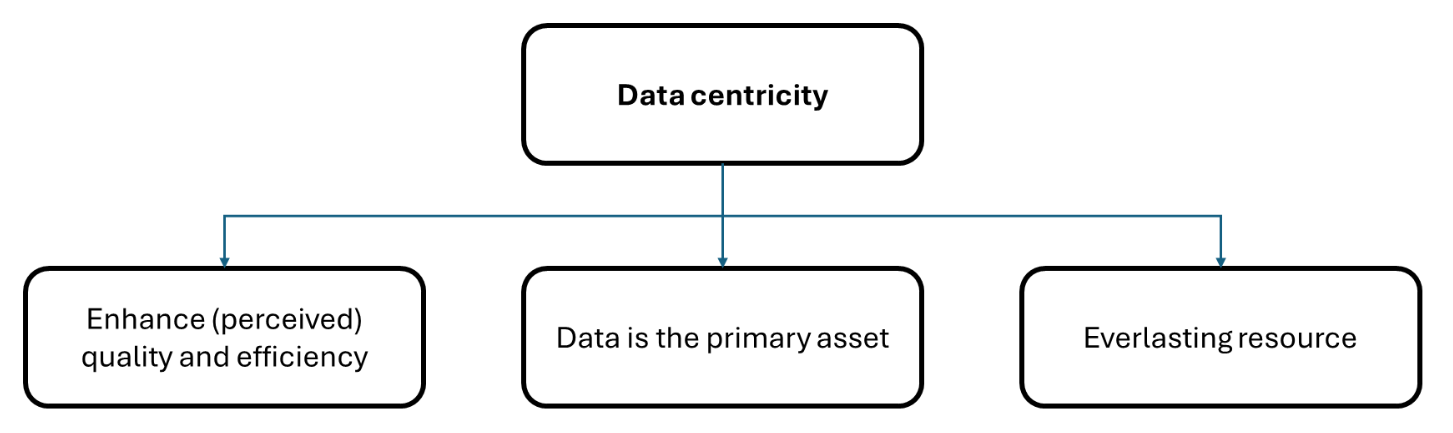
Our goal to become data centric can be broken down into three parts:
- We use data to uplift the quality of our current products and services to increase its efficiency and monitor the performance
- Data is the primary asset because applications are ephemeral
- Data is everlasting and can be used to create any service or product to fulfill new (created) demand
Enhance (perceived) quality and efficiency
We should use Data conscious to harness the potential of enhancing the quality and efficiency of our products and services. Data (but especially metadata) is the core asset to improve processes and IT systems. Where it be automation of process, decision making by humans or machines or detecting patterns we have not foreseen or want as an effect. But also to communicate with our beneficiaries or business partners that we control the narrative about our operational performance and someones weaknesses.
Data is the primary asset
The current Enterprise Information Systems (EIS) paradigm is centered on applications, with Data as a second class citizen. But Data is thé assets for which the application is created so Data should be the primary Asset to be managed. Applications should therefore be allowed to visit the Data, perform their magic (apply logic) and express the results of their process back into the data layer of the organization. Data should be globally integrated sharing common meanings, being exported from a common source into any needed format for any relevant party.
Everlasting resource
As Data is an everlasting resource that can be re-used for any new type of service or product in the (near) future it should not only be managed in the application of it’s creation but on itself. Therefore Data must be self-describing and does not need to rely on an application for interpretation and meaning. So if Data is produced and distributed its meaning should be part of the Data delivery. Also Data should be expressed in open, non-proprietary formats.
Inspired and based on the datacentric manifesto
Wil je meewerken aan deze nieuwe werkgroep/do you have interest in participation in this workgroup?
- Wil je meewerken aan deze nieuwe werkgroep? Stuur dan een e-mail naar education@dama-nl.org
- Do you want to contribute to this new workgroup? Please send an e-mail to: education@dama-nl.org
Geen Resultaten Gevonden
De pagina die u zocht kon niet gevonden worden. Probeer uw zoekopdracht te verfijnen of gebruik de bovenstaande navigatie om deze post te vinden.